Hello from the other side of hiding in Europe during Japan’s extended summer / record-breakingly rainy September. It is I, Modo-san.
I was working on a book in London. And then co-leading a Walk and Talk in Norway. And then participating in an artist retreat in Italy. Erroneously, I thought we had been approaching “layers season” in Tokyo. False alarm. It’s 29℃ and about 80% humidity today. American tourists are still in shorts. One day soon a sweater might be worn in this great city without sweaty regret. But that day is not today.
I made a notebook. It’s called ⬤. You can read about it here. And buy it here. I’ve been using prototypes of this notebook for the last six months. It’s just a simple notebook, but I love it. Does the world need more notebooks? No, but I did. (So I told myself.) Yearly / Lifetime SPECIAL PROJECTS members get big discounts, of course. They make for nice holiday gifts. If you order today, they’ll arrive in just a few days, worldwide. So you’ll have to hide them until the holidays. I believe in you! (Also, thank you to everyone who has ordered one so far; they’re selling faster than expected.)
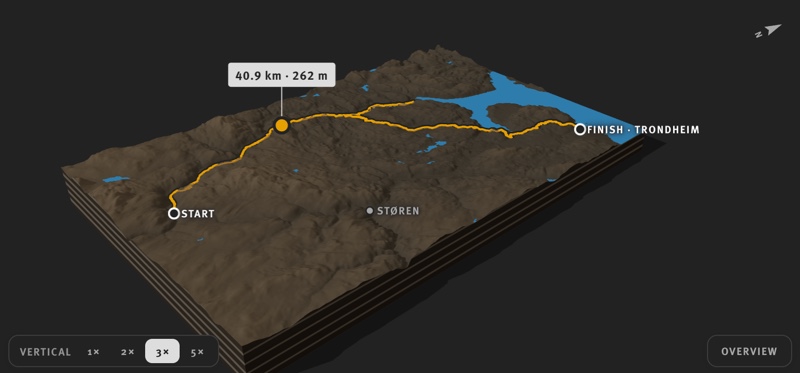
I was looking to organize all my GPS / GPX data from all my walks since 2013, which is about when I started recording walks in earnest. That was the itch to reach for Claude. I had it scour Strava and Gaia and my computer for .gpx files, organize by time and location, and put them in a folder for me. It took a while; there were a lot of them.
Is this useful? Vaguely? It’s been helpful to me simply for the sense of — wow, that’s quite a bit of walking. And to be able to easily grab GPX files for reference.
But with Claude (aka: the magical application replicator), etc., the value of making these pieces of software effectively drops to zero, leaving all the value in the project’s utility (or non-utility). Before, part of the announcement of something like a “walk archive” would have been marveling over the knitting together of the pieces, of the engineering, of making something like this happen on the web. Wow! Rotating topographic maps! Sans LLMs, it would have taken me (at least) 10x longer to make. This was the case with the Walk Kumano / Koya Bound site I produced in 2016 by hand — it was a gnarly mess. The JavaScript, the map, the movement, the scrolling — these became the main events because they were so rare. The story and photographs were, sadly, second (in the eyes of most visitors).
Going forward, by default all software will be whittled down to brass tacks: Yeah, you made a fancy walk interface, but what for?
Getting to that “what for” more quickly is a good thing. Yes, you can give anything a 3D view now, but will anyone care? Did anyone care before? Or were we mostly marveling at quiet software audacities?
The mantra you should be repeating to yourself daily is: Read Good Things. (Also: Watch Good Things.)
For some reason I hadn’t read Caitlin Flanagan. How had I missed her all these years? Style and smarts and humor. And so prolific! Not reading her was a huge loss for my brain. Don’t let it be for yours. Who else have I missed? Please let me know.
I saw Jaws with my father in the summer of 1975, the year it came out. When we walked out of the Oaks movie theater in Berkeley, California, we were giddy, punch-drunk. It’s a perfect movie—a big, exciting American movie. From its opening minutes you live inside of it, your regular life suspended somewhere behind you. Waiting for my mother to pick us up, we noticed that we were both vaguely on guard against shark attacks, even though we were standing on Solano Avenue, where the only dangerous sea creatures were down the street in the King Tsin lobster tank. The tagline of the marketing campaign was “You’ll never go in the water again,” and my only non-Jaws thought during the movie was I am never going to the beach again.
Having recently watched Jaws for the first time, I can attest, it struck me as an artifact that’s rare today. See also Flanagan’s incredible write-up on Top Gun and its sequel: “Cruise’s official love interest in the film, Kelly McGillis, lumbers in and out, and watching these two fulfill their contractual duties of performing sexual attraction to each other is embarrassing. We want to see Maverick with Goose.”
What a testament to man—how noble in reason, how infinite in faculties!—that he continued doing anything else after the advent of online porn. Plenty of women, of course, consume and enjoy or create and profit from porn—people of every sexual orientation and gender identity do. But the force that through the green fuse drives the flower (and the money) is heterosexual male desire for women. And here was porn so good, so varied, so ready to please, so instantly—insistently—available, that it led to a generation of men who think of porn not as a backup to having sex, but as an improvement on it. They prefer it.
Where would this take us? Well, now we know. The heterosexual man can now have what many see as a rich sex life without ever needing to deal with an actual woman.
Population decline has been fomented by many things (IMO, it’s mostly because we don’t have a “good story” about the future), but infinite, always accessible pornography is probably not not part of the cause.
Anyway, Flanagan writes expansively. Go load up your digital reading device of choice. Here she is on her family’s friendship with the great Irish poet, Seamus Heaney:
What did people want from Seamus Heaney at that time? Everything. There was tremendous pressure for him to turn his poetry into a form of opinion writing and take moral command of the situation. He would never have done anything like that. He was a poet, not an on-call political-versification machine. More than that, he understood that what was happening didn’t fit into a neat rubric of oppression and colonial rule. This was a 14-year-old headed to band practice who was abducted, hooded, and murdered. This was an 11-year-old on her way to school when a bomb exploded in her father’s car. This wasn’t an academic debate about the Stormont government or the British army’s casual use of rubber bullets. This was hell.
Before I recommend a giant, ridiculous, metastasized Hollywood spectacle of a film, let me recommend a more muted, better, more honest one: Like Father, Like Son (Apple TV Store link; I think “buying” films on Apple’s store is the highest signal you can give to support a movie digitally). Hirokazu Koreeda, 2013. Won the Cannes Jury Prize (Koreeda nabbed the Palme d’Or for Shoplifters in 2018). What a successful piece of cinema — sensitively directed, acted, written. Quietly eviscerating social commentary on “aspirational” contemporary Japanese life. Go in blind; read as little about it as possible. Being of a smaller, non-Hollywood budget, it resists doing things a script like this would have done in LA, and is all the better for it. One of the most emotionally “riveting” things I’ve watched in a long while. Now I need to go back through Koreeda’s oeuvre.
OK, with that out of the way, here’s the Hollywood pitch, the antonym to the quietude of Like Father, Like Son:
Digger is great, it’s a great film. I loved it. I loved it so much I saw it twice in three days. You should go see it while it’s in theaters. I may go see it again. I kept thinking after the first viewing: Did I hallucinate the goodness? I did not. It’s good. The negative reviews are nuts. It’s the only way I can square them: an epidemic of nuttiness. (FWIW, the film is nearly a 4 on Letterboxd, which is high.)
A few reviews said something to the effect of: A swing and a miss! Ha ha! Which is an even more insane thing to say. Iñárritu and Cruise knew exactly what they were making, what they were aiming for, swung hard, knocked the leather off the ball, and executed flawlessly. A swing and a miss would be to miss the ball entirely. Now, you can dislike the ball, you can dislike where the ball landed, but you can’t say they didn’t bash the thing into low orbit with millimeter precision.
Somewhat related: I found Adam McKay’s Don’t Look Up (2021) to be particularly weak, a mid-Covid misfire that, despite nabbing DiCaprio, got only an anemic two-week theater run before landing on Netflix. Digger is what DLU in many ways wanted to be, and gets us there. (FWIW: I like McKay’s The Big Short (2015).)
I enjoyed the hell out of Iñárritu’s Birdman (2014) when it came out. Watching it twice in quick succession. You expect weird films to come from indie places, but it’s rare when Hollywood makes weird ones. And even rarer when they make weird ones that succeed at their purpose. These should be celebrated. Amid the deluge of Marvel Nothingness (Nic Cage, recently: “Marvel is glorified WWE.”) to have Not Marvel (and Not Pixar) is special.
Craft-wise, you can see where Digger’s $125 million budget went. Gorgeous art direction, costumes, makeup. Great score by Cosmo Sheldrake. My only complaint is the film is about ten minutes too long. I know exactly the scenes I would have chopped. (And sort of know why they weren’t chopped.) But who cares, it all works in the end.
Yes, it’s Iñárritu but it felt less explicitly Iñárritu than usual. Digger was Wes Anderson’s Grand Budapest Hotel (2014) and Gilliam’s Brazil (1985) and of course Dr. Strangelove (1964) and felt in part like a Birdman redux (which makes sense, since it’s the same writing team of Iñárritu, Dinelaris, and Giacobone, with Sabina Berman joining for Digger). Though chimeric, it somehow coalesced into a working whole.
It’s impossible to discuss the mechanics of Digger without spoiling it. So I’ll save that for another day. Simply, I implore you: Go check it out while you still can in the theaters. It has categorically bombed. $17 million domestic so far.
Why has it done so badly? A few things: The title is terrible. The ad campaign has been subpar. The posters are weirdly off-putting (the colors?). The trailers have been inscrutable, with their main purpose being: Look how wacky Cruise is! (Somehow without him seeming as entertaining as Les Grossman.) That doesn’t get butts in seats. And then the initial press response was so tepid, if not downright hostile, that the deal was sealed. Dead openers are unrecoverable. It failed to “make magic” in the realm of public consciousness. But I can see why Cruise and Iñárritu were so gung-ho about promoting it: I would be very proud had I been part of this film!
I guess these are guys who can absorb a $200 million loss (including marketing). But, ugh, you hate to see it when something this good gets so body-slammed at the box office. Meanwhile, Obsession is at $522 million worldwide (!!!). Notable: Obsession opened at $17 million (the total domestic gross of Digger thus far).
It’s an interesting moment for media; nobody knows nothing.
“I imagine you both at home, looking out the window into your cold, barren Conneticut [sic] meadow.” — Steve Jobs writing to NeXT logo designer Paul Rand in 1996
Judd Apatow’s Norm Macdonald doc is out. It’s great. Norm was a special creature.
Everyone is dunking on this, but note: Apple’s HomeView ad feels like human-generated slop. That is: Someone made a spreadsheet of features they had to show off. Contracted humans then produced a draft of a video showing off all the features under the auspices of implausible family life. That video shipped. The entire focus was on the spreadsheet. Claude, generate ad, leave no features out.
Meanwhile, naturally, someone actually slopped together an ad (warning: x.com link) that is ridiculous but at least coherent, and probably more aligned with device use cases than Apple’s official ad. In the end, it’s hard to make a meaningful ad without a meaningful product. Jobs would never have let this thing sit on Paul Rand’s table, facing his cold, barren meadow.
Note: Something about this ad situation rhymes with the software situation.
I’ve been running around Tokyo with some visitor friends this last week, and am in awe of the seeming randomness of tourism distribution. Of course, Shibuya at large is basically a full no-go zone. But within Shibuya, you’ll have a line of folks who look like they stepped off a cruise ship waiting to get into a mid, smoke-filled bar. The bar just happens to be on a “list.” Why that bar? On that list? It feels as arbitrary as choosing a McDonald’s in a city with fifty of them. Social media makes the mundane sticky in ways that never used to happen.
I keep thinking about the mid-2000s as the last moment of “authentic” tourism to major cities. Meaning you could go, and mostly experience the place as the locals did. (Older travelers laugh and say: Oh, kiddo, the ’60s was the last time you could do that.) Now you have to stretch to find those kinds of experiences / interactions. I spent four nights in Rome last month (my first time visiting), and … wow … central Rome is rivaling Tokyo for Disneyland vibes.
Weirdly, I didn’t feel the tourist crush as acutely in Paris. And, of course, in London, I was far outside Tourist-ville. But also: European cities are good at absorbing tourist hordes. Brick and stone and all that. Japan is brittle — physically (tiny wooden buildings) and culturally (the smallest missteps cause great disruptions) — which makes the situation here feel more amplified.
Tourism: something something issue of scale (see below).
Poet Anne Carson is a beautiful weirdo. I am glad she is recognized (recently: Nobel). We need to celebrate more beautiful weirdos (see below).
About twelve years ago I started giving talks about “scale and abstraction.” Back then social media was the prime example of a hyper-scaled negative-externality-generator with dubious benefits. Scale is the critical word in there. Group chats with friends normally don’t generate chaos. Algorithmic group chats between a hundred million people sometimes do. Scale scale scale. Part of what makes AI’s exponential rise feel so disquieting is the ramping of scale (speed of code production, announcements, generation of video / audio, amount of data consumed / generated, energy infrastructure construction; leading to: crying mathematicians, eulogies for programming, etc.). AI is the endgame of complete scaled abstraction: all human thought, production, feeling, and innovation, thrown into the blender of the machine (“the model”), able to extrude any desired combination into any desired shape. I mean, it is very cool, and also very weird, and ethically fraught (but here we are).
If scale and abstraction make us uncomfortable (at the very least they make us less empathetic), then it’s only natural we presently feel awash in deep discomfort. Abstracted discomfort, mostly — like you can hear the Langoliers over the horizon, but can’t yet see them, and don’t entirely know if they’re heading this way. This discomfort may account for the theological bent so many AI employees seem to (parodically) embody. A common way to deal with existential discomfort is to go celestial, frame it within the pantheon of great cosmic events, the rising of Christ, the extinction of dinosaurs, the first shimmy from protozoa to multicellular organisms, the Big Bang, the movie Snakes on a Plane, the foundation node of our simulation. Otherwise, you start to go nuts because staring into the maw of infinity makes you nuts. Go nuts from being overwhelmed, or go nuts from total belief (see recently, semi-apocryphally, yet believably: AI employees taking up smoking because they believe in the soon-coming cure for all cancers). I try to walk the thin line between.
I feel both: Great optimism. And great bummerdom. The bummerdom is mainly because as power consolidates via capital, the consolidators are getting less and less interesting. This is sort of axiomatic vis-à-vis the demands of contemporary trillion-dollar businesses.
Are Stripe’s John and Patrick Collison the only guys of that echelon with multivariate curiosity? Kind of. They seem to be among the few reading books, widely and critically. (I tried to get Patrick to go on a ten-day silent vipassana retreat years ago and his response was basically: Yeah, but do you know how many books I can read in ten days? Fair enough, I thought.) Instead, most folks pulling the strings don’t care about poetry, seem to have little understanding of romance, love, familial duty, have never sat quietly with their own thoughts. Have never gotten lost for the sake of getting lost. Have little empathy for the great many. On one hand, the “purpose” of humanity is (has always been) to get us to the next thing, which may not (will almost certainly not) be “human.” I’m actually fine with this (one of my personal heresies is that we aren’t that “special” and are a “stepping-stone species,” our magic trick of metacognition being analogous to that first multicellular pop; I feel this in the same way I feel there will eventually be a cataclysmic earthquake on Japan’s main fault line — as a kind of dispassionate truth). But: the “purpose” of humanity is also to fuck under the night sky on a Greek island, eat freshly caught grilled fish slathered in butter and lemon with your hands, lick red wine off the body of your lover, and be OK with dying a stupid death.
Let’s not forget that.
Did you make it down to the bottom here? Thanks for slogging through the monthly brain dump. Write more in notebooks; it’s good for the noggin.
As always, more soon. And for the love of god, please be weirder.
Still swelteringly yours,
C
P.S. Here’s another fun personal heresy: I think we should have a twenty-year period when only women can vote and hold office. At the very least it would be an interesting experiment.