Ridgeline subscribers —
Hey there! This is Craig Mod broadcasting Ridgeline from my new home-cooked newsletter software, mailbot2000. An issue of Roden came out last week and was sent via mb2k, if you’re subbed to Roden and didn’t get it, please let me know / check your spam. If you are getting this and didn’t “Yo” me for Roden, please reply with a little “Yo!” to let me know this is arriving (it also signals to Gmail that this isn’t spam). OK, onward!
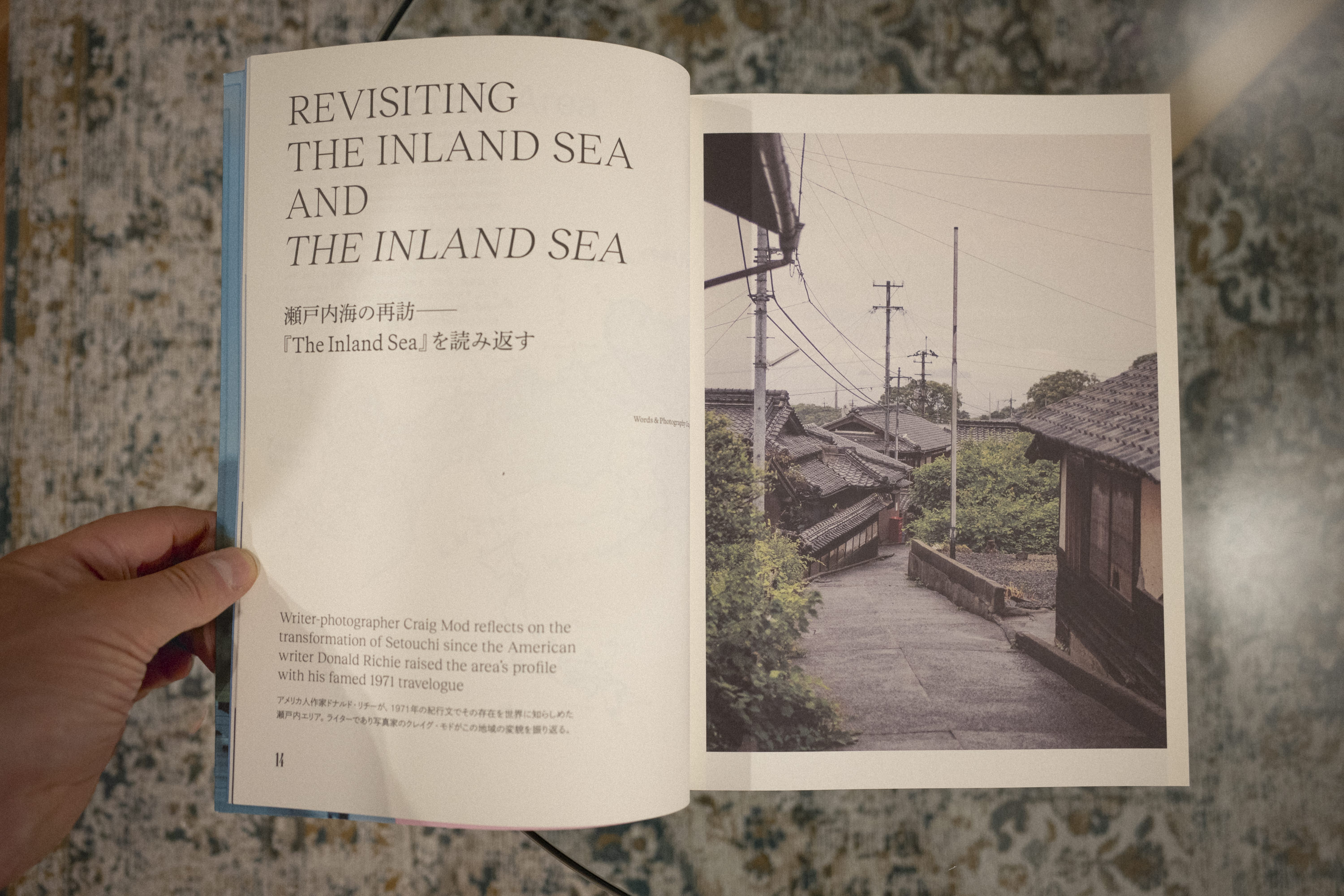
I had an essay come out in The New Japan, a gorgeously produced new magazine about regional stuff in Japan. W. David Marx is the editor-in-chief. NOT A HOTEL funds it.
The new issue is about Setouchi / Setonaikai aka the Inland Sea. Setouchi is the sea + surrounding area. Setonaikai is the sea itself (in English we tend to just lump the two terms together). I wrote about visiting the Inland Sea at large, using Donald Richie’s The Inland Sea as context. His book, published in 1971 (but written based off a journal he kept in the early 60s when he was about forty years old), has carried an outsized cultural weight over the years, culminating in various anniversary editions and a short documentary in 1991 by Lucille Carra, narrated by the man himself.
Now, I know a lot of people like this book. (And if you do, perhaps avert your eyes for the rest of this?) But for me, revisiting the book for the first time in years, it instantly became an archetypical anti book, a book embodying how not to write about place or people. The Inland Sea is flawed on an atomic level, and its enduring popularity took me by surprise. Richie seems to be doing some kind of 19th century explorer cosplay — in tone and “gaze” (way, way up on a horse in the sky). Unfortunately, Isabella Bird, Richie is not. Where Isabella’s travelogue from 1878 is, of course, sprinkled with — ahem — casual racism, it was also written in the 1800s. There also isn’t so much a meanness to her gaze, just continuous bafflement and curiosity and annoyance. Her book is funny, smart. Bird is a good writer, if not without her own cultural issues on the page, and she went on a genuinely arduous journey north from Yokohama, all the way into Hokkaido, at a time when “roads” basically didn’t exist and almost certainly none of the people she met had ever seen a foreigner, let alone a female foreigner. Whatever you may think of her, she had gumption.
Bird writes in her preface, “This is not a ‘Book on Japan,’ but a narrative of travels in.” Richie very much wants The Inland Sea to be a Book on Japan (title cased and bold), with the travel being something of an inconvenience needed to achieve the former. Richie is here to demystify and explain all thought and action by the people of the Inland Sea. Almost no Japanese person is given a voice of their own, and if they are, it’s then filtered through Richie’s “understanding.” (An understanding built on shaky language skills.) Richie always knows best, certainly better than the locals.
Richie was also pretty darn angry. Or at least I feel an incredible anger beneath the prose. Particularly in how he thinks about and treats women. “It is perhaps true that the best way to get to know a people is to sleep with them, but this is complicated in Japan,” he writes. The book oozes with this “elevated gentleman lecherousness.” The most egregious example being the chapter where he tries to sleep with a fifteen-year-old, bringing her back to his hotel room, making a move, being rejected, and then imagining what could have been: “I occupied an indulgent half-hour or so with thoughts of what I should have done, what I now decided (safely alone in bed) I had really wanted to do: torn schoolgirl uniform, thighs immodestly up in the air, cries for mercy, etc. Eventually, however, I grew bored and fell into a deep and satisfactory sleep.” That Richie thinks this is even worth committing to the page is some indication of how beautiful he considers the smell of his farts.
On a certain inn: “No man should attempt to stay at such a place by himself,” he writes. “The loneliness is stupefying, and the maids are virtuous.” On writing about the fashion of young women he sees in a coffee shop: “These young ladies might, at first glance, prove more amenable to his efforts. I doubt it though. They are virtuous. It is just that fashion has decreed the international whore-look.”
Meanwhile, he sleeps with a prostitute all the while narrating her internal dialogue, and then gets mad at his wife for showing up in the middle of his trip.
Richie, in the 60s, was still grappling with his homosexuality, and this book was a bit of a coming out for him. One of the best scenes in the whole book is one where he finally shuts up and just describes a sexually charged moment with a young guy working for a shrine, stuck on one of the islands:
“There, that’s better,” he said and sighed, adjusted his loincloth fundoshi, and sat down again. “It feels good to take those silly clothes off sometimes.” Then: “I wish it was light.” Then: “You got a light? I’ll show you something.” I felt in my pockets, produced my lighter, held it out to him. “Go on, light it,” he said. I did. “Look here,” he said and turned his near shoulder to me. The sudden flame blinded me, then I saw his bare brown shoulder and raised the lighter. The skin was marked, beautifully traced with blue and red. It was cherry blossoms, extending from his neck down half his forearm. “I was going to get a big carp going up a waterfall on my back but I ran out of money. Tattooing is expensive and it takes time. Just this here on my arm took almost a month. The reason is the red. It’s poison. You can only do about a square inch every other day or else you get sick—throw up.” I put my hand on his traced shoulder, ran my fingers over the skin. It was smooth, warm. “That cost a lot of money—got it done in Hiroshima. They don’t usually do it so well nowadays, but this old man, he was a real master.”
I can’t tell you how lovely it was to come across this passage. Finally, Richie steps back, showing not telling, with a compassionate (if hyper-hornballed; you can all but feel Richie’s erection under the page) gaze, minus the rape fantasy.
Again, when he shuts up there are glimmers of insight:
THE COAST IS BEAUTIFUL, BUT the other side, the sea side, is spectacular. The islands stretch, one after the other, some near, some far. Sunny, open, fragrant, they welcome. They do not, however, smile. In Europe these islands would be openly gracious. There would be a plaza or a piazza or a plaka; there would be something more genial about them. Japanese geniality is of a different sort. It is more private. Nothing is shown openly. The house front is closed, the face is blank. Once past this, once inside, then true friendliness begins. Only in the bar, the restaurant, the hotel, the home, and only after you are identified and committed—only then do geniality, hospitality begin. Japan is not a place strangers easily enter—no matter the charm of the islands, the grace of the people. There is no tradition of anything but a politely hidden suspicion of the unknown wanderer. To be anonymous is, in Japan, to be nothing. Only after your name, occupation, family, history are known do you become real.
There’s an additional dissonance beneath everything — Richie projects deep knowledge, but he can’t read Japanese and, as far as I can tell, he’s a terrible speaker of the language as well. (He gets better, this is still early on in his Japan life.) He talks about his “Tokyo accent” getting in the way of ordering water. This is … this is not a thing. The inclusion of which is obviously an attempt to “claim status” and “establish himself” as not only an “expert,” but one who, again, is even more learned and understanding than the locals.
Richie’s Inland Sea has not aged well. There’s some value in it as a document of a moment in time, but it would have been all the more valuable if he had done more observing and less pontificating, and certainly less indignant projecting. (There’s probably a perfect twenty-page edit of the thing.) Speaking for myself, and I suspect many other non-Japanese who have made a long life in Japan, choosing to live in a country where you are “forever on the outside” comes from some place of trauma. It’s a strange way to make a life. Richie didn’t “have” to be in Japan, in the same way I don’t. (So I feel like I empathize with much of his emotion burbling under the page.) This places you in a complex position, and sometimes that complexity spills out as anger that can take decades or a lifetime to smooth out.
He eventually got divorced and embraced his sexuality more fully. I think he found some peace living next to Ueno Park, and certainly his later writing about Japanese cinema is seminal and opened up the mid-century Japanese greats to the world. He seemed quite at ease with whom he had become later on in his life; I remember him overtly hitting on me at a party many years back. Then, he seemed jolly and scrubbed of malice if not pontification. I wish that version of him had traveled the Inland Sea. Because as valuable as his other work may be, his book of 1960s thoughts on the Inland Sea is a hard pill to swallow today.
My piece for The New Japan doesn’t go into any of this, obviously. But I figured it was worth making note of. What does or doesn’t make for good travel writing? How much of yourself to bring to the table? Etcetera. Go read Travels with Myself and the Other by Martha Gellhorn for travelogue joy without the anger. Or Chatwin’s In Patagonia for a brilliant fool in a land he doesn’t really know, but one he explores with joy and a poet’s eye. Or Paula Fox’s The Coldest Winter for a beautifully written travel memoir.
Richie ends his book with the line: “I don’t care if I never go back.” He insists that he “meant that I didn’t care if I never went back to the U.S.A., but some readers thought it meant that I didn’t care if I never went back to the very place I had been describing. They were wrong.” I’m not sure that they were. Or, at least: I feel like he was talking about not going back to a place dark and personal, more than a physical locale. I don’t think the line had anything to do with the Setonaikai or America. Or, he was just being a sloppy poet.
As for the Inland Sea — just go yourself! Go to Naoshima and Teshima and Inujima and all the other “lesser” art islands, but also take a few ferries to the weird islands, the unknown art-free islands. Stay in a moldy old inn run by a couple so old they might very well be pickled. In a strange way these smaller islands are not much different from when Richie visited. And you’ll learn a lot more about them just sitting on the dock, watching whatever life might be left passing by, keeping the complicated voice of a cranky dude, far, far in the past.
C
Not subscribed to Ridgeline?
(A weekly letter on walking in Japan)
This essay is from the Ridgeline newsletter, mailed out May, 2026. Thoughts? Email me@craigmod.com.

Craig Mod is a writer and photographer based in Japan. He's the author of the books Things Become Other Things and Kissa by Kissa and is a MacDowell, Ragdale, and VCCA writing fellow. His essays and articles have appeared in The New York Times, Eater, The Atlantic, California Sunday Magazine, Wired, Aeon, New Scientist, Virginia Quarterly Review, The New Yorker, The Morning News, Codex: Journal of Typography, and elsewhere.
He writes newsletters, oh yes, newsletters: Roden & Ridgeline.
The work on this site is supported 100% by paid memberships and book & print sales.
Whatever you do, don't follow @craigmod on Bluesky or Instagram.