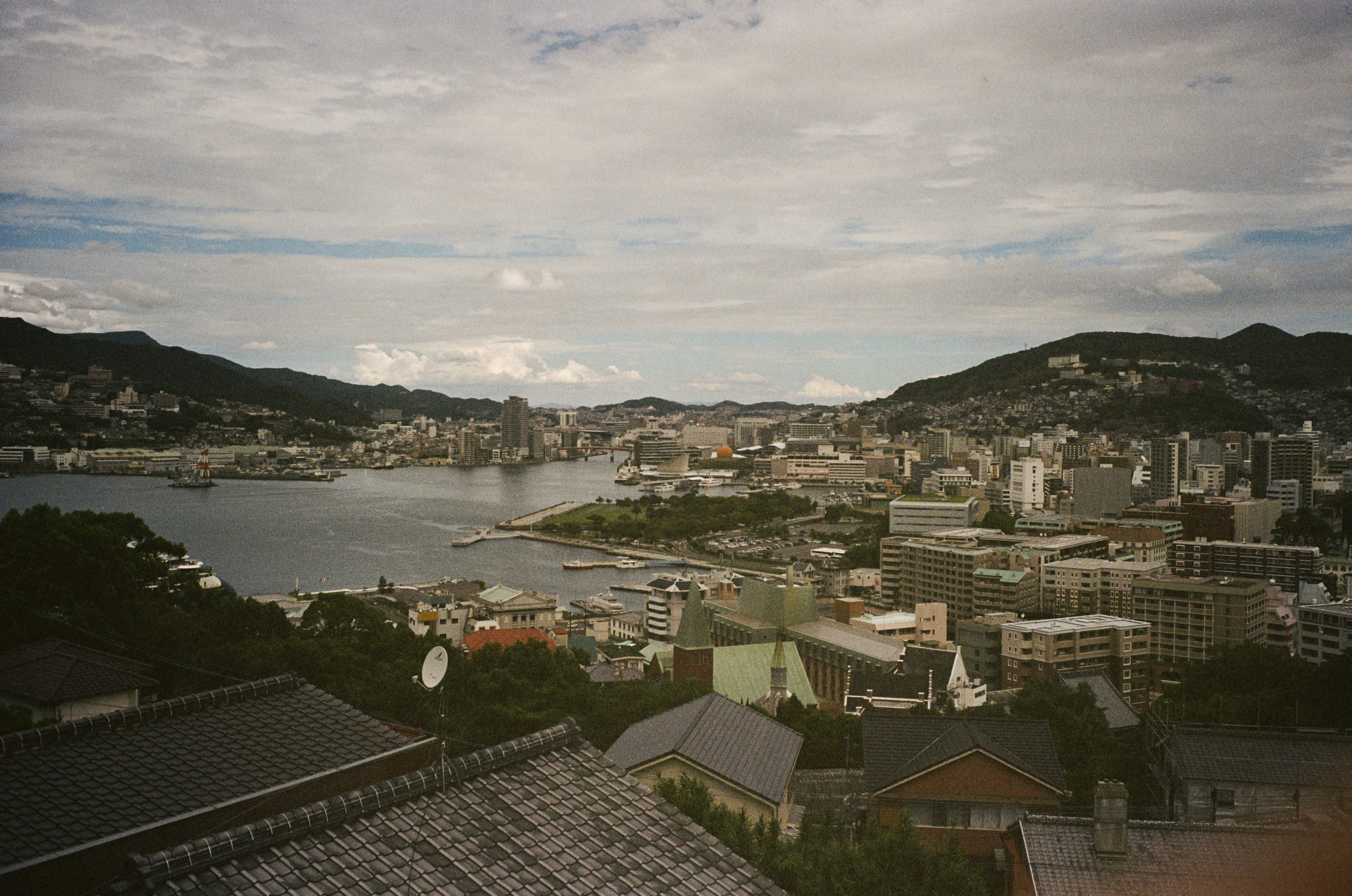
My 2026 New York Times Pick — Nagasaki
Nagasaki is an amazing city worth visiting in 2026 and beyond
Ridgeline Transmission 221
Ridgeline subscribers —
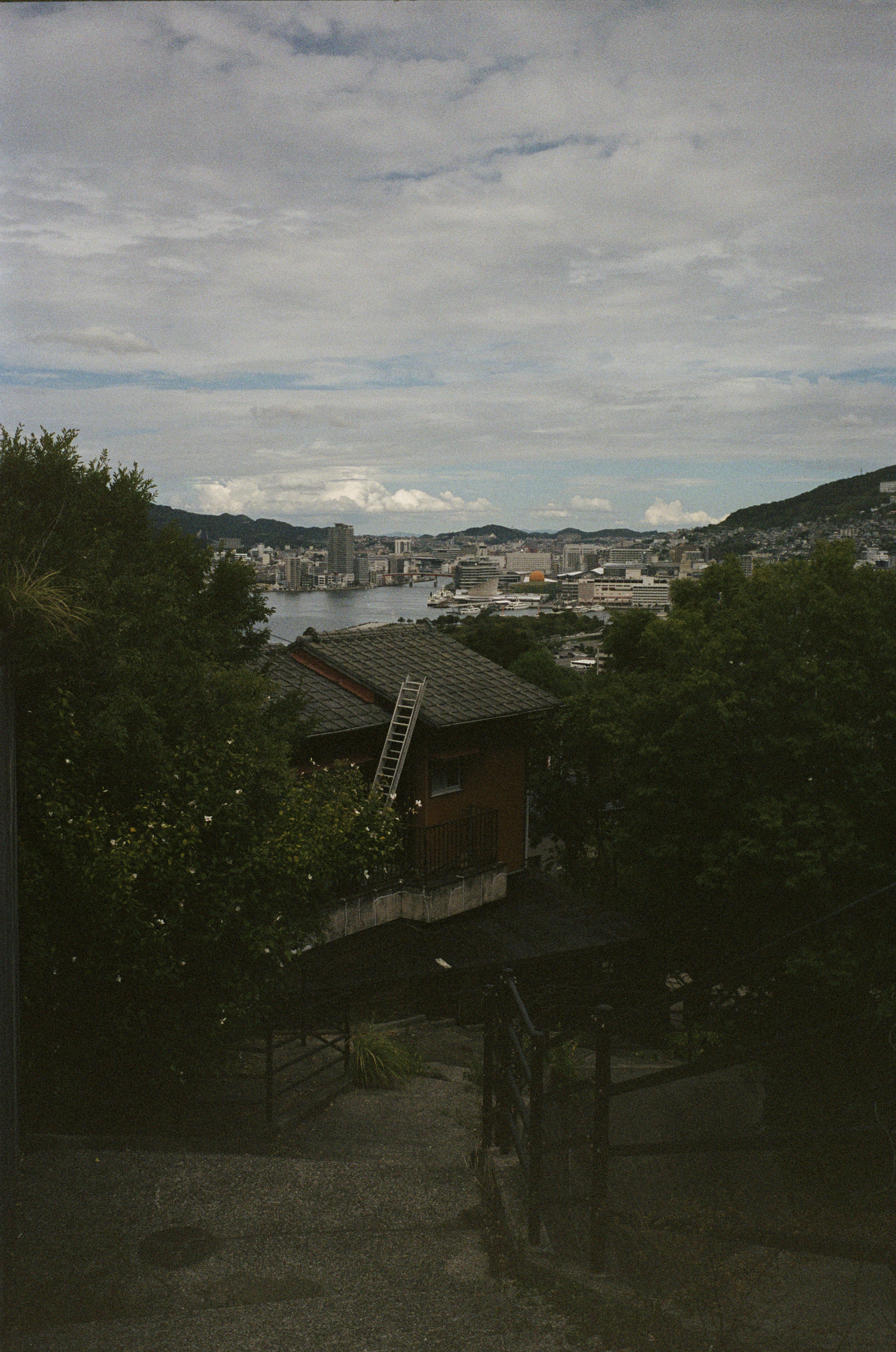
Nagasaki pivots around its harbor, into which flows the Uragami River. Mountains covered in small homes and shops rise alongside; at night, the whole valley sparkles like a jewel. An easy ropeway ride up Inasayama lets you take it all in. In the afternoon, the city bustles with locals.
It’s because of these reasons and many more, that I selected Nagasaki for my 2026 New York Times “52 Places to Go” destination. I’m delighted to see it make the list! (We don’t know if our picks have made it or not until the list is published.) I’ve been to Nagasaki five or six times over the last twelve years, and it’s always felt like a special place, but it wasn’t until I was having coffee with Sam Holden a few years ago, that his passion (he’s a verifiable Nagasaki (and Onomichi) maniac), for the city inspired me to take an even deeper look. So I went back, and it was, indeed, great.
Here’s what I wrote up for the Times:
Unlike Hiroshima, which was almost completely obliterated by an atomic bomb in August 1945, the urban core of Nagasaki, America’s second target, was spared when the bomb missed its mark. This gives the city center a kind of sliding-door surrealness: This was all supposed to be gone, but somehow it survived. As the threat of nuclear proliferation spreads around the world, travelers have a potent reason to visit — and Nagasaki has never been more ready for them, thanks to the completion of a major redevelopment project around the main train station. Visit an 800-year-old camphor tree. Around the corner is Fukusaya, a confectionery that has sold cakes since 1624. Try a “milk seiki,” a frozen dessert drink, at Fujio. For nearly 40 years, Hideyuki Natsume — the soft-spoken son of atomic bomb survivors — has been running Milestone, a jazz bar. Finally, visit Glover Garden, then cap it all off with grilled mochi at Umegae Mochi Kikumizu, a nearly-140-year-old, third-generation pounded-rice shop.
Choosing Cities
The question I get asked every year is: How do you choose the city? A few things. The city should be somewhat off the usual tourist route (what’s the point of recommending a place everyone already knows about?1), but not wholly inaccessible (the Shinkansen helps), but most importantly: It should be filled with a kind of vitality and life missing from so much of the Japanese countryside these days.
I’m extremely (perhaps overly) sensitive to over-tourism. By choosing a place that requires just that extra little bit of effort to get to, you filter away the majority of what I call TikTok Tourists,2 leaving behind visitors who are genuinely interested in, and wiling to engage with, the locale respectfully and with the notion of “mutual elevation” strongly in mind. Based on conversations with citizens and officials and shop keepers from the cities I’ve recommended over the years, nothing approaching the over-tourism issues of Shibuya or Kyoto has yet happened.
As I’ve walked thousands of kilometers around the country, the effects of depopulation and deindustrialization become apparent, quickly. (It’s one thing to hear the word “depopulation” over and over, it’s another to walk through it.) Towns evaporate into thin air, and with that so too does local culture. Shutters come down, and it’s unlikely they’ll come back up any time soon.
Many villages and towns across Japan are simply “unsavable.” That is, the industries that served as their backbone (logging, fishing, cloth production, etcetera) are gone, and with that loss of jobs, so too comes a loss of family building. Once you understand this, mid-sized cities like Morioka (pop. 280,000), Yamaguchi (pop. 200,000), Toyama (pop. 400,000), and Nagasaki (pop. 400,000), take on greater import in the context of preserving local culture not found in the big cities.
I first noticed this when I did my “Tiny Barber” ten city tour back in 2021. I was somewhat shocked to find coruscating, unique life pulsing in places nobody had ever mentioned to me despite my several decades of living in the country. This kicked off my now multi-year selection of mid-sized cities I think are worth taking the time and effort to visit.
By shining a light on these cities, we’re shining a light on alternative ways of living beyond the mega-cities of Tokyo or Osaka or even Nagoya, places where most of the jobs have consolidated. These mid-sized options are more and more critical as cultures becomes more and more homogenous. Across the country, multi-century run matsuri are stopping because of a lack of participants. Local food culture is being lost. These mid-sized cities are a small bulwark against the total loss of local culture. And furthermore, a life in a city like Nagasaki can be a beautiful thing, wholly different — and in many ways, more interesting, richer, and more fulfilling — from a life in Tokyo.
My goal with any of these recommendations is to “boost” these mid-sized cities, to help them establish even firmer roots, to believe in their goodness (sometimes it can be hard to see from the inside), and to hopefully inspire some of the younger folks (middle school, high school kids, especially) to consider building businesses and lives in their hometowns.
Nagasaki
As I mention in my Times writeup (which is capped at 150 words), Nagasaki feels like it occupies a strange position in the pantheon of Japanese cities. It’s known, yes. But it gets lumped with Hiroshima by dint of atomic detonation by US forces, but Hiroshima ends up “owning” most of the “brand” of “city that was bombed.” The tragedy of the bombings should never be diminished, but it feels unfortunate for Nagasaki to forever exist within a kind of nuclear penumbra on the edge of Hiroshima. There is simply so much more to the city than the location of a second war tragedy. It’s a city that deserves to stand on its own.
Through and through, Nagasaki is beautiful. Dare I say: it’s a city with romance in its blood. The little passages up in the historic Minami Yamatemachi area are some of the best only-in-Japan style lanes around: Windy skinny things hugging the mountains, steps, strange angles, mixing Taisho Era west-meets-Japan architecture, with salt-of-the-earth working-class everyday Japanese homes. To walk around, one can’t help but wonder just how they got the building materials up to some of the perches.
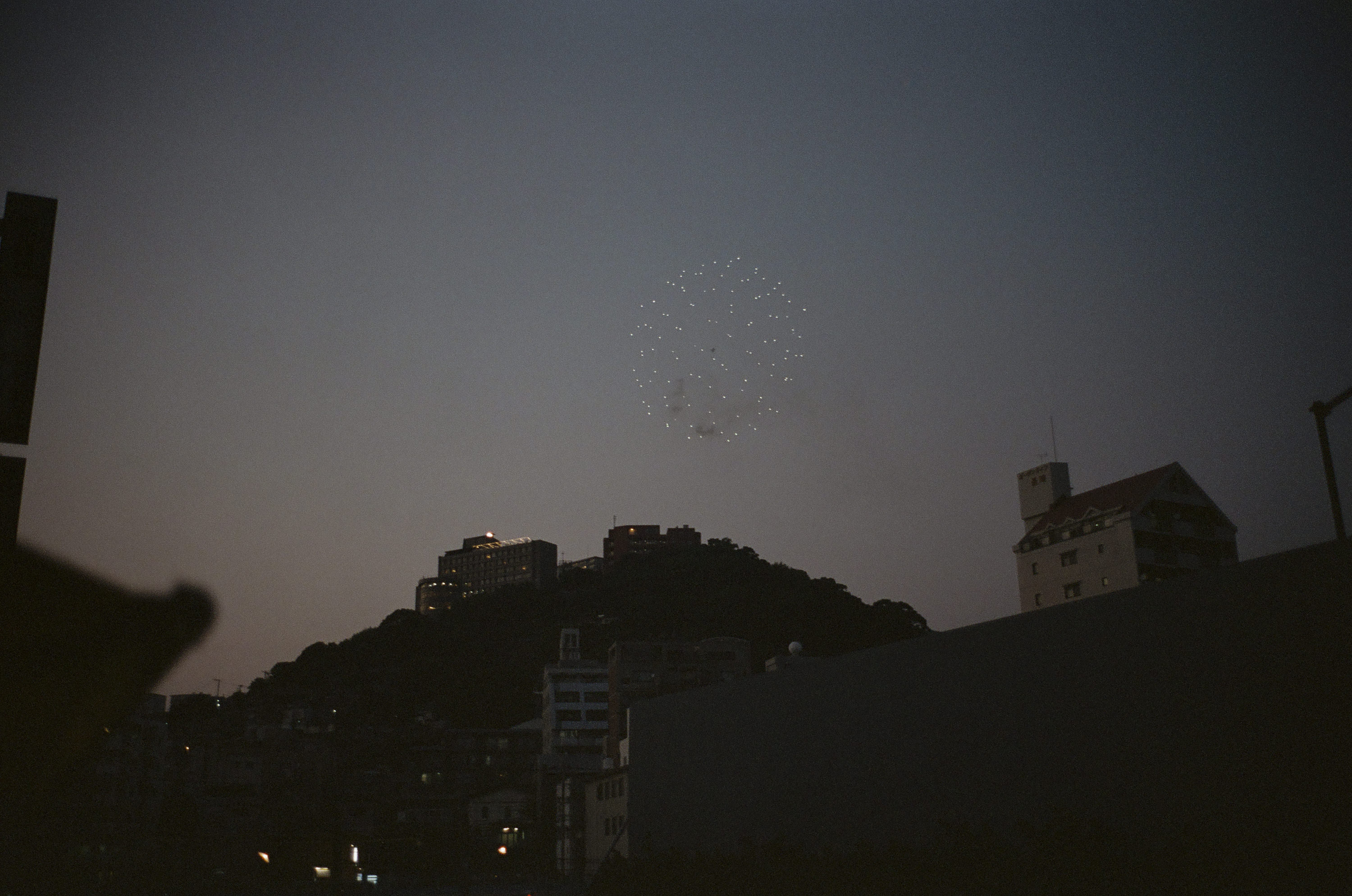
It’s a city where fireworks spontaneously appear over hillsides:
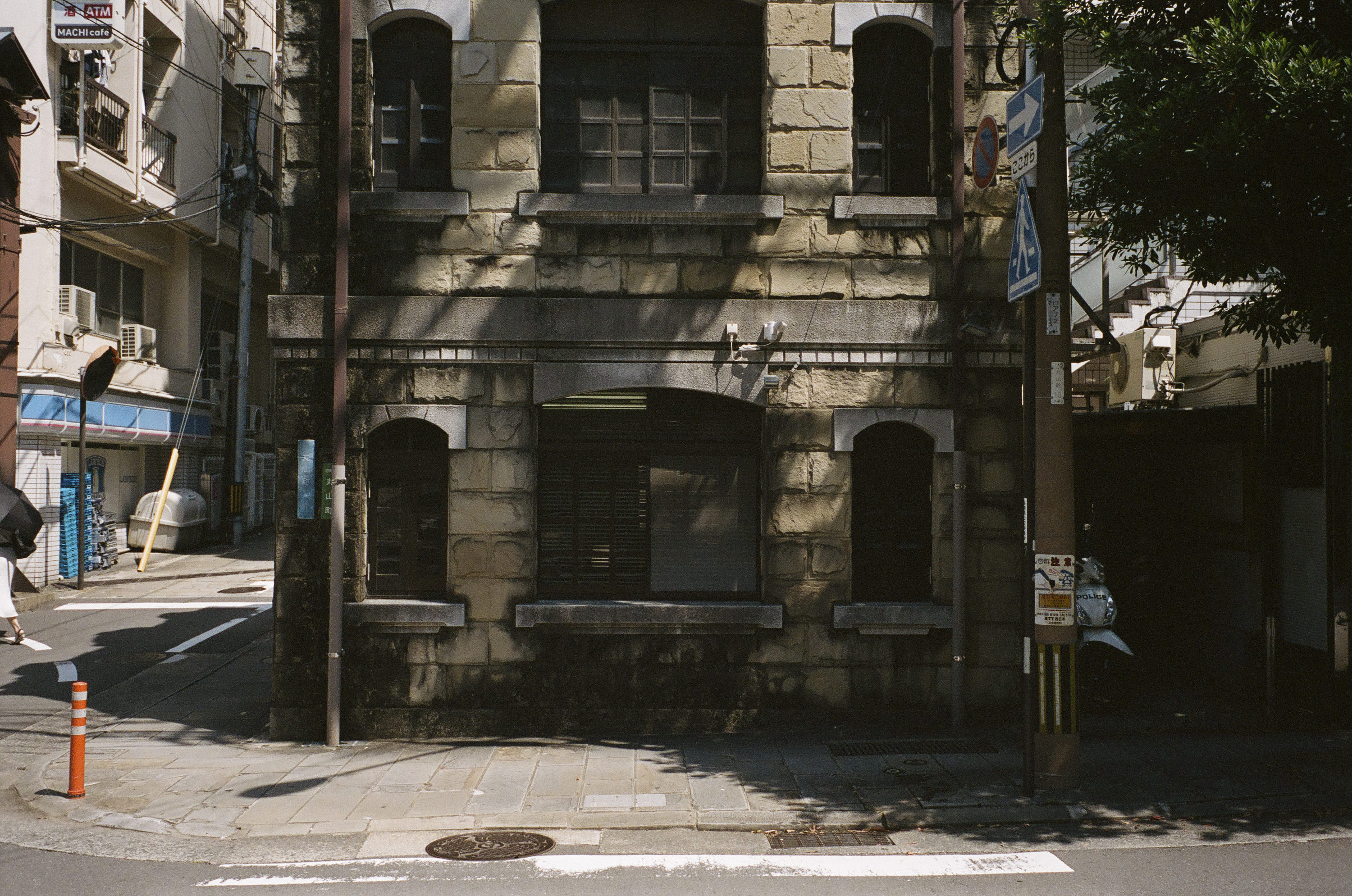
It’s a city with perhaps the most beautiful police box in all of Japan:
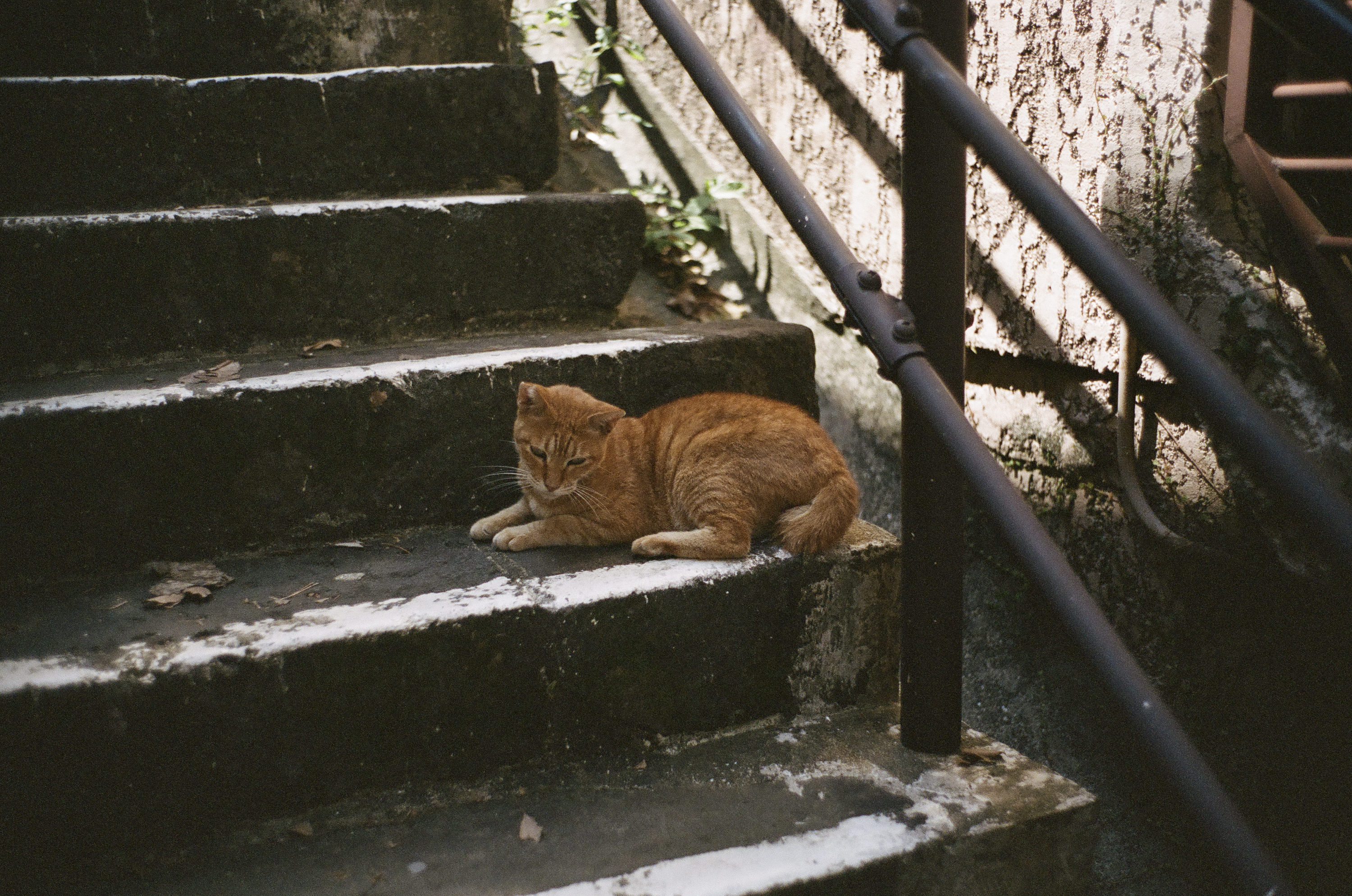
Are there cats? Oh yes, there are cats. Surly cats lurking about the steps all over the hillside:
People always talk about how Japan “mixes old and new,” but in reality very little of true old and new are mixed here. Nagasaki is one of the rare places where it actually happens. Ports have always been mixing spots. But many Japanese port towns were bombed or destroyed during the war or suffered in other ways. Yokohama fell apart several times, between earthquakes and fires and fire bombings. The historic port area of Nagasaki managed to wiggle on through it all, impressively intact.
Simultaneously: Nagasaki’s relationship to the bomb feels more critical to acknowledge than ever. As nuclear arms rise to hitherto unseen global levels, as geopolitical tensions hit fever pitches, and as unstable leaders seem to be more the norm than the exception, remembering what these weapons are capable of and why we should never use them again is paramount in 2026. Nagasaki’s Urakami district (a quick tram ride north of the central station; its Peace Statue by Seibo Kitamura is incredible) was the one hit by the second bomb in 1945. Some 70,000+ people were killed. The valley topology contained most of the blast (saving downtown). It destroyed the largest Catholic Cathedral in Asia. The Cathedral commemorated the persecution, over centuries, of the Urakami Catholics — some 8000. The Review Conference of the Parties to the Treaty on the Non-Proliferation of Nuclear Weapons is happening in Nagasaki in April 2026.
As for tourists, Nagasaki feels under-visited (Hiroshima veers on over-touristed). It’s incredibly walkable — those hillside lanes beg to be investigated on foot. Yet, everything feels like a brisk thirty-minute walk away, making it a city a traveler can hold in their head. Furthermore, Nagasaki has never been more ready for visitors: the city just completed a massive redevelopment around the station adding a few new hotels (a 5-star Hilton, a 4-star Marriott (if you’re into those sorts of things)), making lodging easy. You can fly from Tokyo to Nagasaki in under two hours, Shinkansens run straight from its station, allowing it to serve as a great jumping off point to explore Kyushu. Historically and architecturally, Nagasaki is where much of the west entered Japan. Dejima (well-preserved as a museum site right in town, alongside the Nakashima River) was the country’s sole outpost to the west for centuries. David Mitchell wrote a great novel — The Thousand Autumns of Jacob de Zoet (amzn, bkshp) — in which you can glimpse a bit of what life was like on the island, two hundred years ago. Nagasaki is the site of Japan’s first western restaurant, and is also where coffee first hit its shores. As global travel goes asymptotic, it’s fun to remember that Nagasaki was the originally mixing point of Christian, Chinese, Dutch, and Japanese culture.
A fifty-minute drive east lies the stunning Unzen Amakusa natural park and onsen village. The once-favorite-of-Nakameguro restaurant, Beard, actually opened just next to the park. Nagasaki is full of delights.
Here’s a few extra shops I enjoyed during my visits that didn’t make it into the Times piece:
- Kariomons Coffee — one of the best third-wave cups of coffee you’ll find in the city
- Hitoyasumi Books — extremely local bookshop with a tiny café in the back; slink in, keep quiet, and enjoy a coffee surrounded by some indie Japanese books (just around the corner from Spectacles Bridge)
- Couch Pizza — serving up some very quick “NY style” slices; incredible if you need a little boost as you walk between the million other places to visit and see
- Dimples — a funky, local, Jamaican-inspired izakaya
- shaba shaba — OUTSTANDING Japanese curry; I went back several times
- Saromanian — I didn’t make it in here, actually, but boy did it look cool
- (right behind Saromanian is the old brick gate to Daion-ji Temple; worth a quick peek)
- Hitomachi — a cute “very” local coffee shop
- If after all that walking you need your back stretched out, Charin Tip Thai Massage will do the trick
As always, with all these places, the name of the game is to tread lightly — be quiet, don’t go into these shops with a big group, speak softly as you enter (loud talking on the street should be quickly modulated upon entry), and have cash ready (and please don’t hand over bills that have been folded four times, extracted from some minimalist, tiny wallet (this is actually quite disrespectful!)). Follow these notes and almost any shop will be glad for your patronage.
My favorite interaction of all my Nagasaki visits happened at a little coffee shop on Sasayaki-zaka. I entered. No customers. I sat down at the counter. The master — close-cropped gray hair, white shirt, bow tie — stood silently. I asked if smoking was allowed. The master said, Sadly, no, no smoking. Oh, I said, I thought for sure this place would allow smoking. In fact, I said, I picked this place 70% because I thought I’d be able to smoke a cigarette here.
The master didn’t take his eyes off me. He reached under the bar. Pulled out an ashtray. Placed it on the bar. And slid it down to me like he was Moe sliding over a beer in a Simpson’s episode.
I howled with laughter. He sat down and pulled out a cigarette. Together we smoked. He showed me his muscles. It was fabulous, the whole thing, muscles included. In a weird way, that interaction made the trip. We talked for an hour or so. Just lovely chatting about life and history — of the shop, the city, the country, our lives — over a shared appreciation of nicotine. The “Nel” cloth drip coffee was great.
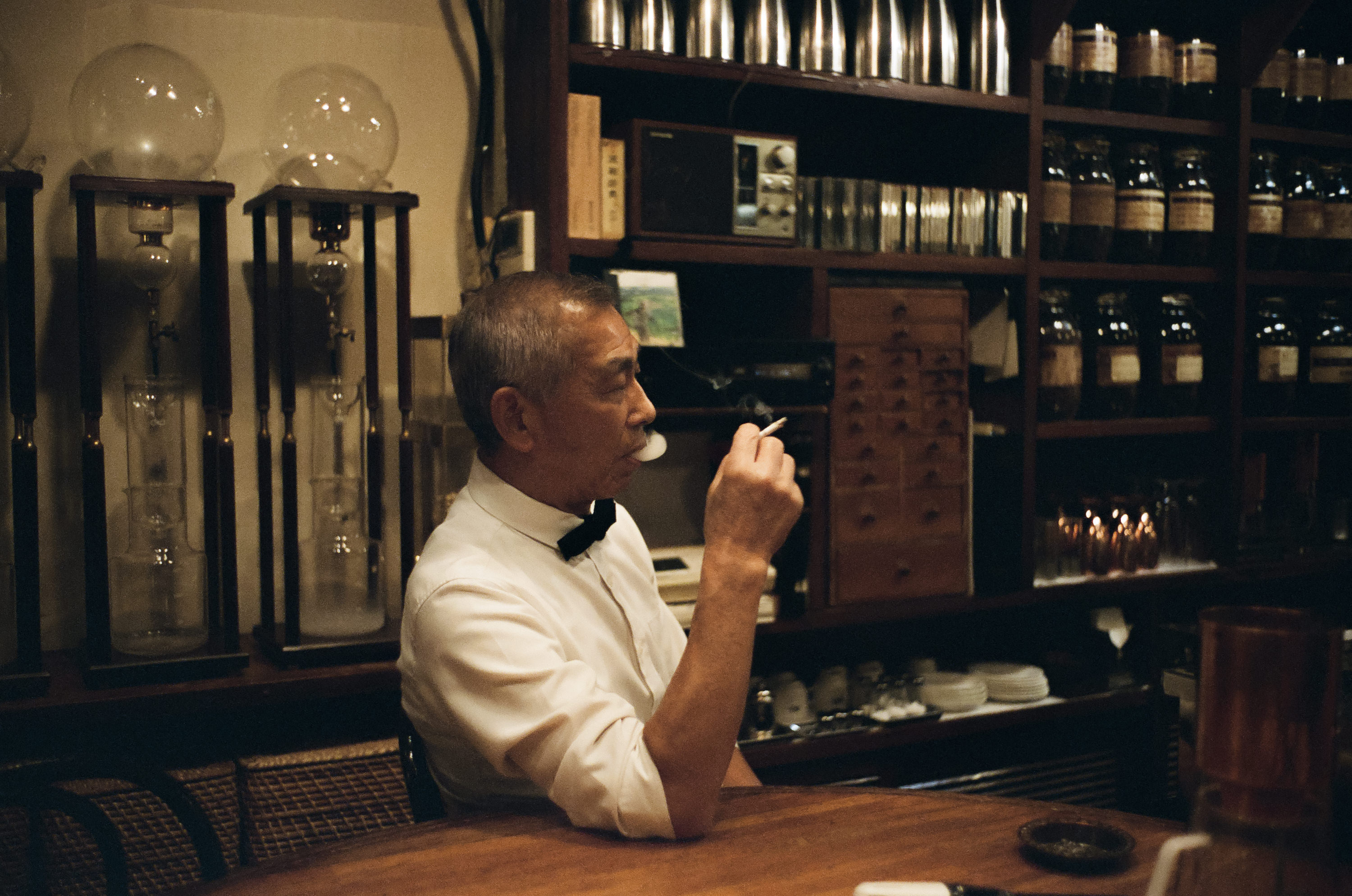
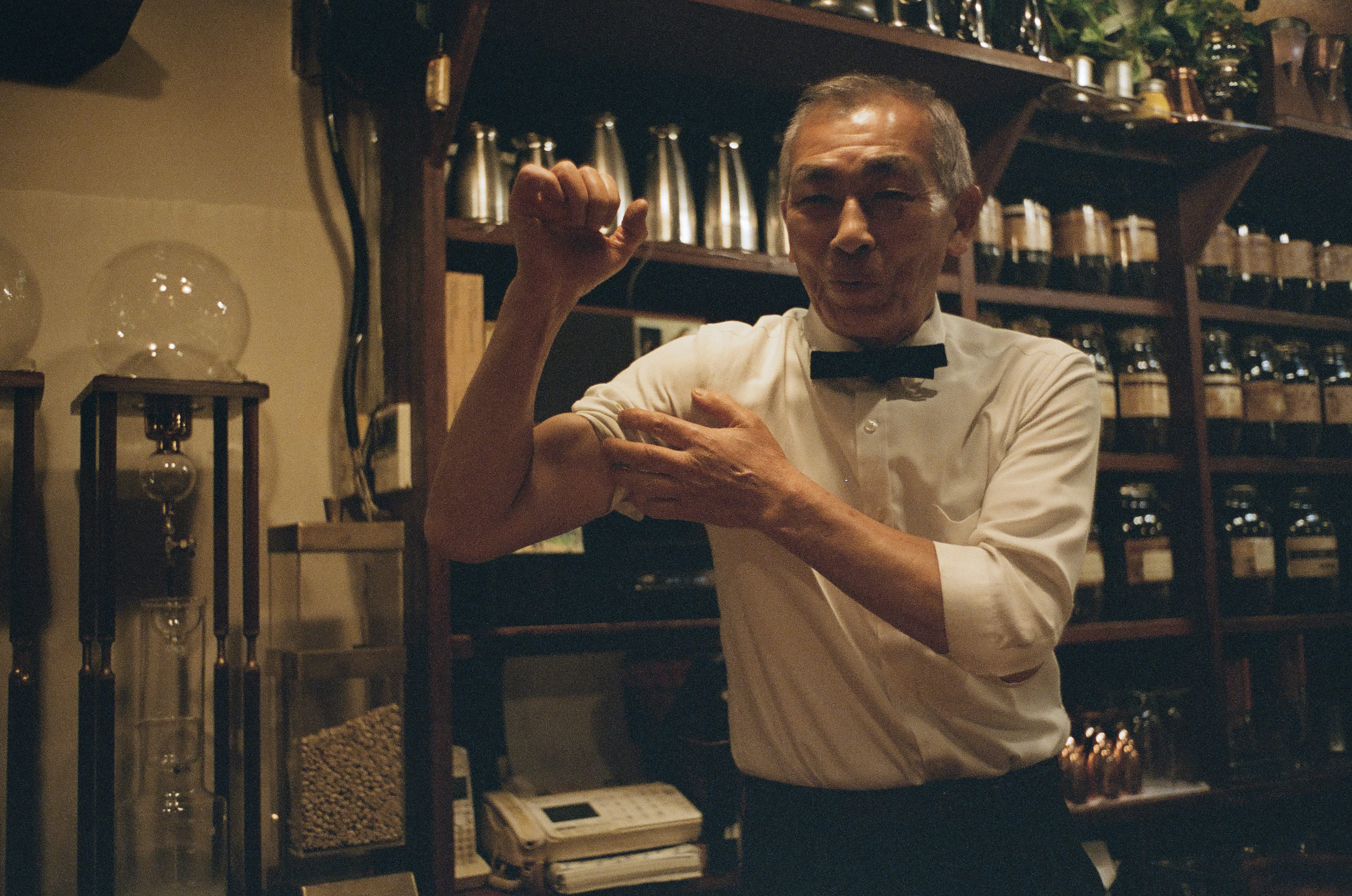
Everyone in Nagasaki had a bit of that master’s vibe. I felt welcome most anywhere I went. The people of Nagasaki are replete with yoyū. It is a city that rewards exploration, and there is much to explore.
Mr. (91) and Mrs. (86) Matsumoto, the owners and grillers of “Nagasaki’s Famous” Umegae Yakimochi, the third-generation mochi shop noted in the Times piece, have those delicious yoyū vibes through and through. The whole shop feels like it was extruded from a vibe machine at the turn of the previous century’s previous century. Whatever is happening in that little shop, cannot be faked, and cannot be replicated. Nothing like this will ever exist again. They gave me about fifty pounds of mochi (OK, maybe not fifty) for a few bucks. I ate it sitting in Daitokuji Park, just above the shop. It was a heaven-sent moment.
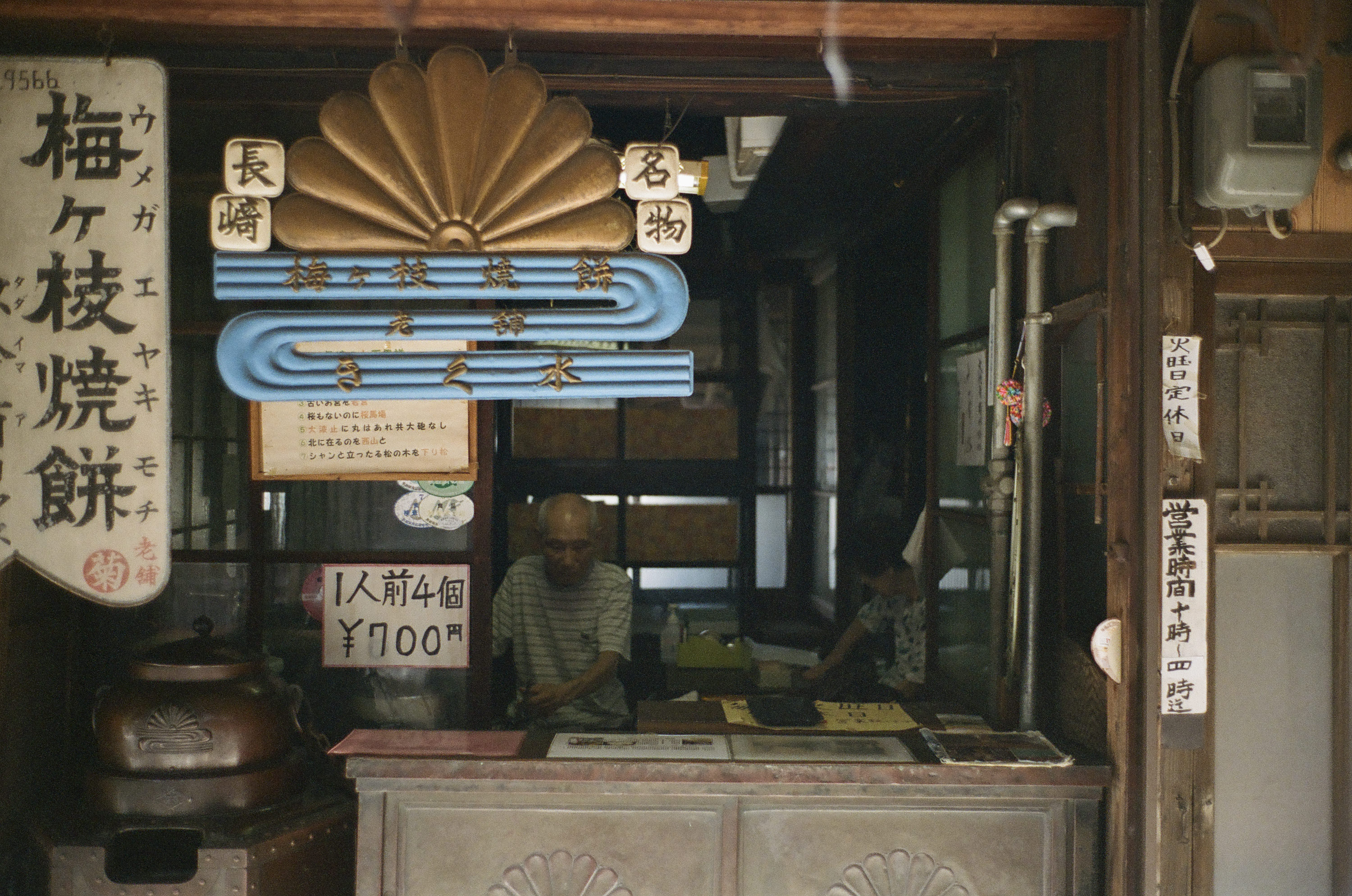
When the local newspaper approached the owner, Mr. Matsumoto, asking him how he felt to be selected by the New York Times his response was, New York What? I ain’t never heard of such a thing (「ニューヨーク?それはなんね?全然そんなの聞いとらんよ。びっくり」).
Mr. Matsumoto, please never change. And everyone else, hurry up and eat some mochi.
So — Go! Visit Nagaski! Rent a car! Then drive around Kyushu. Go to Saga. To go Karatsu. Say hi to Den for me. Go to Kumamoto. Go to Aso-kuju National Park. Go further. Go to some onsen. Go see some pottery being made. Go eat some fresh fish. This is a wildly under-visited part of Japan. It is delights upon delights upon delights.
Noted
-
Not just in the context of inbound tourists, but also for Japan-based tourists. The biggest impact of these Times recommendations are, through extensive Japanese media coverage, renewed interest in / awareness of these cities in the minds of folks living in Japan. ↩︎
-
An 800-year-old camphor tree can only truly be experienced in person, not as a talking head filming selfie-style in front of it. ↩︎
Not subscribed to Ridgeline?
(A weekly letter on walking in Japan)
This essay is from the Ridgeline newsletter, mailed out January, 2026. Thoughts? Email me@craigmod.com.

Craig Mod is a writer and photographer based in Japan. He's the author of the books Things Become Other Things and Kissa by Kissa and is a MacDowell, Ragdale, and VCCA writing fellow. His essays and articles have appeared in The New York Times, Eater, The Atlantic, California Sunday Magazine, Wired, Aeon, New Scientist, Virginia Quarterly Review, The New Yorker, The Morning News, Codex: Journal of Typography, and elsewhere.
He writes newsletters, oh yes, newsletters: Roden & Ridgeline.
The work on this site is supported 100% by paid memberships and book & print sales.
Whatever you do, don't follow @craigmod on Bluesky or Instagram.