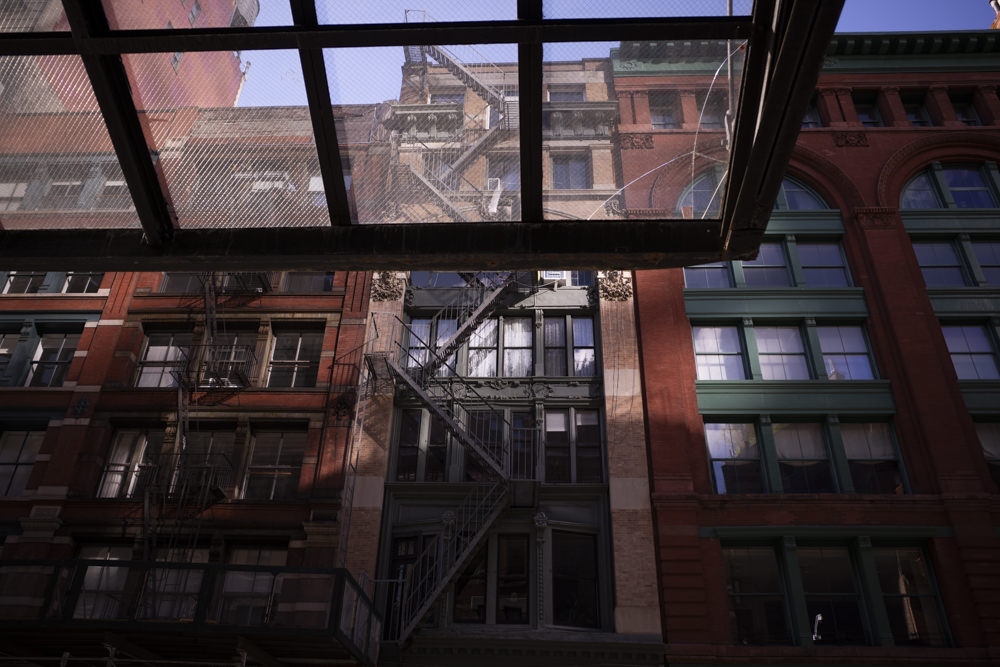
Go Knicks! Or something like that. What a time to be in NYC. (So everyone tells me.) I watched the last game in the courtyard at a Jane Jacobs–designed co-op in the West Village surrounded by kids and crunchy adults and then wandered in a collective stupor through the streets of New York until about two in the morning bearing witness to decades of repressed joy. A few nights later, Matt Rodbard and I were having dinner in Fort Greene and in walked Spike Lee, looking as happy as any a man could look.
They tell me it isn’t always like this but I’ll take it if this is what the city’s giving.
I’m Craig Mod, author of Things Become Other Things (amzn | bkshp), this is my Roden newsletter, and I’ve been busy … attending to about six lifetimes’ worth of life.
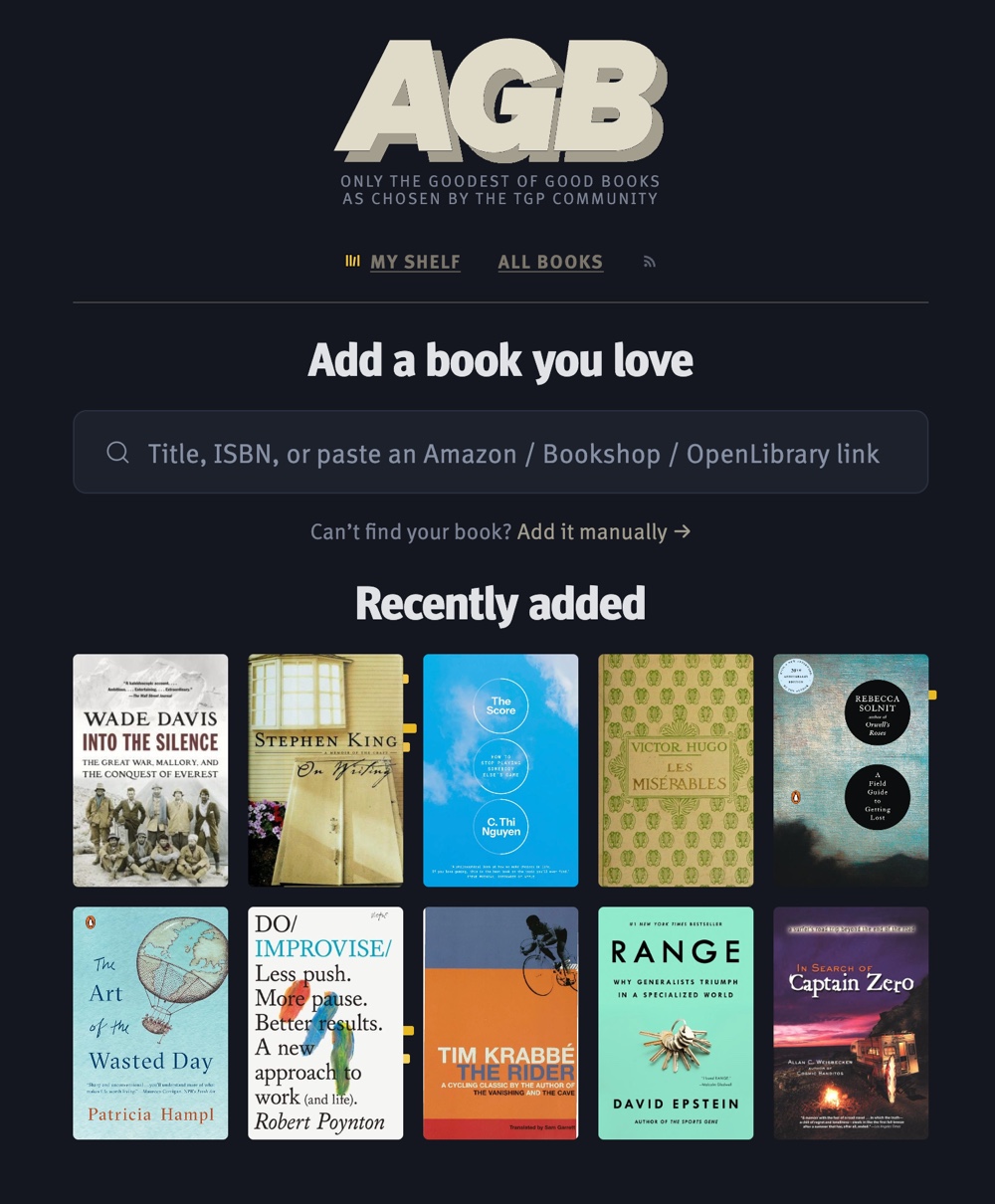
Goodreads is a hot mess. Over on our SPECIAL PROJECTS membership site, we have The Good Place, which is our clone of Twitter but without everything that makes Twitter horrible. It’s my favorite place to post. We tend to blab about books over there but don’t have a good way to “save” book threads (everything on TGP disappears after a week). So I made A Good Book (AGB), a version of Goodreads without the badness. AGB collects “The goodest of good books from the TGP community.” The community has already added hundreds of books. It’s not meant to catalog everything you read but only the best things you read. So no need to post about a book you hated just to assuage completionism pathologies.
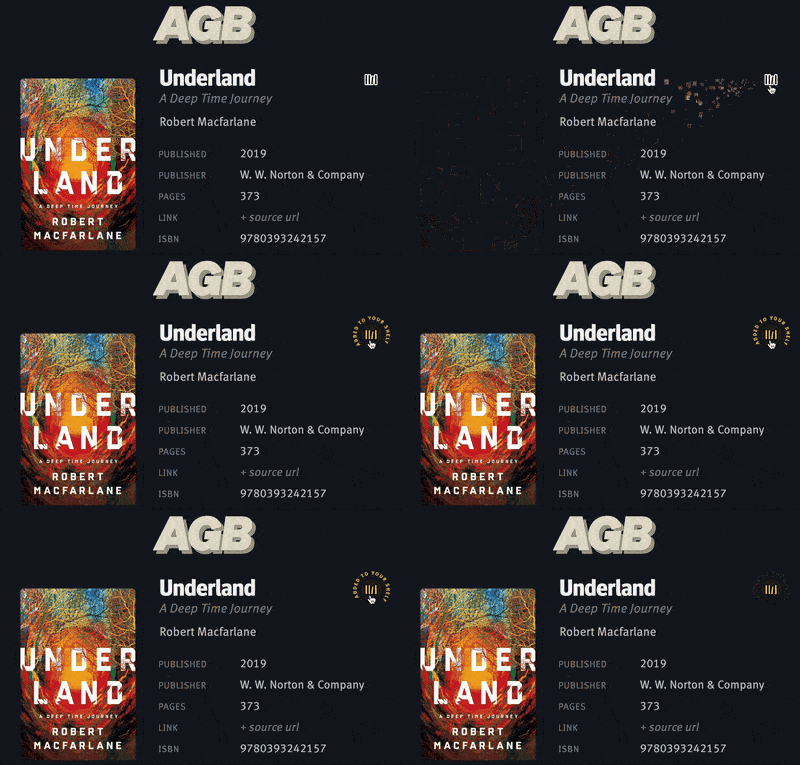
I built this with Claude, of course, over the course of five or six days, chipping away at it a few hours a day. A lot of iteration. Since all the books are good books, the idea of “favoriting” was redundant. So popularity is based on engagement: How many notes / quotes a book has, and how many shelves it’s on. I tried to inject some whimsy. The more quotes a book has the more “tabs” poke out of the side. Adding a book to your shelf is quite fun. I encourage SPECIAL PROJECTS members to poke around and contribute a book or two you love.
Adding a book to your AGB shelf
TBOT Fine Art edition reprint is moving along. Sign up here to be notified when it’s available.
I’m also working on another small “product” to scratch my own itch (and maybe yours too) which I hope to announce soon.
On July 19th I’ll run my members-only board meeting looking back at the last six months of work. A bit later than usual but travel and life mean that’s the best day to do it. Will announce on the SPECIAL PROJECTS-newsletter soon.
I read Dungeon Crawler Carl Book 1 (amzn | bkshp). Am I glad I did? Sure. Will I read another one? No.
I highlighted three sentences in the entire book:
She purred so loud it vibrated my teeth.
“Glurp on that, motherfucker,” I said.
“Are you asking me if I fucked the orc?”
That pretty much sums it up.
The biggest insight I had was that this felt like a perfect format for an LLM-assisted book. Not to be reductive, but the structure is: a series of D&D / video-game-like “fights” with monsters who have abilities / powers, etc, and drop loot boxes. The structure to invite an LLM in to contribute is right there.
I feel like I’m the most broken of borked records, but reading DCC further highlighted how amazing Ursula K. Le Guin’s “genre” fiction is. You can do “dorky” and have it vibrate in the realm of high literature. (See also: Moonbound!)
Speaking of Ursula, I’ve been reading a fabulous collection of her essays: Telling is Listening (which, weirdly, I can’t seem to find available for purchase online anywhere? I nabbed it at McNally Jackson). Smart people committed to strange points of view are all we ask for.
On writing fiction in general:
Because I am not as good at anything else and nothing else is as good. I would rather be writing than anything else.
I still find embodying or identifying most intense when the character is a man — when the body is absolutely not my own.
And on writing Earthsea, which emerged in fits and starts over years, and didn’t really coalesce until it was commissioned (as I always say, external permission is helpful (maybe the most helpful)!):
To be asked to do it was a great boon.
People often ask how I think of names in fantasies … Usually the name comes of itself, but sometimes one must be very careful: as I was with the protagonist, whose true name is Ged. I worked (in collaboration with a wizard named Ogion) for a long time trying to “listen for” his name, and making certain it really was his name. This all sounds very mystical and indeed there are aspects of it I do not understand, but it is a pragmatic business too, since if the name had been wrong the character would have been wrong — misbegotten, misunderstood.
A man who read the ms. for Parnassus thought “Ged” was meant to suggest “God.” That shook me badly. I considered changing the name in case there were other such ingenious minds waiting to pounce. But I couldn’t do so. The fellow’s name was Ged and no two ways about it.
It isn’t pronounced Jed, by the way. That sounds like a mountain moonshiner to me.
In the margins I wrote: And this is why translation is so tough.
I have a thousand other passages highlighted. If you can find the book, grab it!
I’m also about to finish an incredible collection of (linked?) short stories: We the Animals by Justin Torres about the lives of three young boys. An unbelievable amount of chaos and energy is captured on these pages with exceptional brevity and economy of sentence. A short but powerful read, full of far more life than a globe-spanning dungeon.
I’ve been on a “high-brow SF” jag lately. I’d say Calculation of Volume falls into that category. Emma Straub’s This Time Tomorrow does too. “Classic” time loop setup with memory intact. Mystery + father-daughter story. Takes place mainly on the Upper West Side. Some great lines: “She felt like an imposter, like she was wearing a costume made with her own face.” And how can you not love a good jay-walking note: “… the daily ballet of a well-timed jaywalk. Jaywalking, Alice’s only professional sport!”
The other night at dinner, Seth Godin said to me: I think about the book Replay almost every week. Every week?! Having read it some 30+ years ago?! How can you not read a book that Seth has thought about weekly for decades. So I did and it was great. Ken Grimwood’s book is very “American.” It’s a mix of CoV (which is very not American) and TTT (or rather, they mix Replay, since Replay predates those books by … 30+ years). Replay is basically Groundhog Day but with entire swaths of life, not just a day. It never explains why the loop is happening. Much “realer” than CoV in how the protagonist acts (immediately he just tries to make a metric ton of cash on sports bets which is, let’s be honest, what most people would do?). The book addresses the “Can you go back and kill Hitler?” question in a pretty elegant, spooky way. Overall, great. Genre from the eighties done well. Fun side-quest story about making a great movie. Also, the book contains a weird aside about “Showscan” which I thought was a made up technology but apparently isn’t. This is how the book explains it:
Well, Showscan takes that process a step further. It’s shot at a full sixty frames a second, with no redundant frames. Trumbull used EEGs to monitor the brain waves of people watching film shot and projected at various rates, and that’s where the responses peaked. It appears that the visual cortex is programmed to perceive reality at that particular speed, in sixty bursts of visual input each second. So Showscan is like a direct conduit to the brain. It’s not 3-D; the effect is more subtle than that. The images seem to strike deep chords of recognition; they somehow resonate with authenticity.
Meanwhile, in 2026, we bend over backwards to keep our dumb smart TVs from over-interpolating and turning everything into 60 fps garbage.
In long-form land, The New Yorker has a great profile of Colson Whitehead, a guy I met at a friend’s house in Brooklyn about twelve years ago, just the three of us. Oh, what do you do? I asked like a true moron. He was very demure. (By that point he was already a MacArthur Genius recipient.) Said he was working on a “book about poker.”
A bad script is almost always a kiss of death. (Though: A good script doesn’t mean a movie will work.) What are some movies with terrible scripts that succeed? I’d love some examples.
Thinking about this because I saw Disclosure Day — ugh. Blunt was fabulous (I couldn’t help but wonder if her accents were AI assisted though) but working within flawed material. The film basically ends where it should have started. Bummed because I was really primed to love this thing!
Backrooms was also a mess. Again: The script just isn’t there. But kudos to Kane Parsons for doing what he’s done. Lower-budget films killing it in theaters is what we need. Everyone is mentioning Obsession and Backrooms in tandem since they’re both relatively “cheap” movies that have made a lot of money, released within a few weeks of one another. Obsession is the better film by a dozen miles. Made for $750,000 it’s now grossed $371M worldwide. That’s … is there another film that has such an extreme cost:gross ratio? (Backrooms is at $330M worldwide made for $10M). Interesting to note that Curry Barker (Obsession’s director) was also (like Kane) a YouTuber, cutting his teeth with (unsurprisingly) well-produced, very funny comedy shorts. His arc rhymes with Jordan Peele and Get Out (2017) (rewatched the other night; still excellent; but still think the alt ending was the one they should have gone with). Here’s one of Curry’s pre-Obsession short films: The Chair. Looking forward to seeing what he does next.
In other YouTubers-doing-movie-stuff, I completely missed this one earlier in the year: YouTuber Markiplier self-funded his movie Iron Lung, based, apparently, on a video game. Grossed $50M (without, as far as I can tell, “real” distribution). The YouTube demographic is showing up.
I picked up a copy of “Pi” The Guerilla Diaries by Darren Aronofsky about making Pi in 1996-1997. It’s fantastic. Pi holds a special place in my heart as one of the first truly “indie” films I saw at a small theater in Hartford. It really cracked open my skull. The diary starts with him working on the script, through shooting, and then winning Best Director at Sundance. All done on a shoe-string budget.
I do think that friction is helpful in being creative. And Aronofsky encountered piles of it making his film. It almost certainly made it a better movie. Made for $60,000 (financed via $100 donations from friends and family) and grossed almost $5M worldwide. Not bad for not having three million YouTube subscribers.
(FWIW: Disclosure Day, with a budget of $115M, is projected to barely break $100M domestic; nowhere near profitable …)
Big thanks to everyone who came out to the Asheville event earlier this month — we had a packed room, great energy, lots of fun. Glad I hustled down there. What a fabulous nook of America.
It was especially good because parts of Things Become Other Things (amzn | bkshp) take place near Asheville, and Asheville’s bookstore Malaprop’s was where I started working on another (resolutely rejected, unpublished) novel, many lifetimes ago. So it was nice to close that loop — to do a reading of a few of the short chapters of TBOT (a few graphs of which came from that unpublished novel) set in North Carolina.
I also managed to spend some time with family by the shore, in true Americana style.
Went to a soiree in Prospect Park on a beautiful night.
Saw lots of nice light, despite it being June, when in Japan the atmosphere tends to be so thick with moisture the light loses all its edge (and it’s the rainy season).
Wrote a bunch at the NYPL; what a thing to have available to anyone, the vastness of those rooms, a bunch of folks quietly cranking away.
OK, I’m off on a (strange?) 24-hour trip to Florida, and then squeezing in a few more NYC meetings before wheels up for Japan. That’ll clock me out at about nine weeks in the States. It was about real-feel 45℃ here today in NYC, so I’m primed for the incoming Japan swelterfest.
Truly though, what a crazy nine weeks. Unbelievably full with ten thousand moments of delight and joy. Thank you to everyone who helped make this trip so powerful. I’ll be back again soon.
And thanks in general for all the support, for writing TBOT reviews on the Amazon page (probably the only page where that sort of thing genuinely helps), for coming to the readings, and for joining SPECIAL PROJECTS.
Random aside: My Ricoh GRIV really emerged as the MVP of this trip. Glad I brought that little sucker.